
The Underground Mineral Battery: How ERW Basalt Powers the Soil Food Web

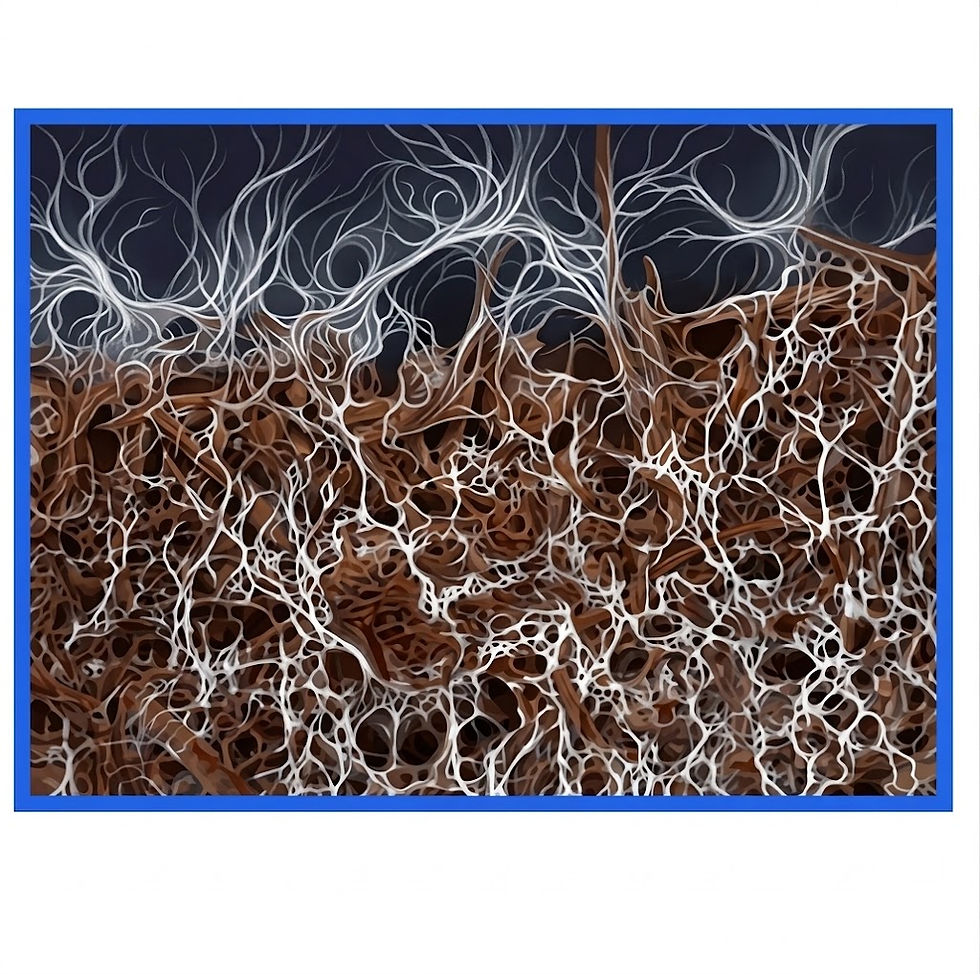
Applying living microbial inoculants, compost extracts, or mycorrhizal spores to mineral-depleted agricultural soil often yields inconsistent results. Without an immediate, insoluble elemental food source, applied beneficial microbes quickly deplete localized nutrient reserves and experience population crashes (Alpine Minerals Research; RTE White Paper, 2026).
Alpine Minerals ERW Basalt #40- Sand operates as a biological "mineral battery," supplying the physical scaffolding, paramagnetic resonance, and elemental reserves necessary for native and applied microorganisms to establish permanent, self-sustaining soil colonies.
1. Fungi Act as Precision Mineral Miners
Soil fungi do not break down parent material uniformly. High-resolution atomic and nanoscale imaging shows that fungal hyphae actively seek out and colonize discrete, iron-rich titanomagnetite inclusions and calcium reserves embedded within volcanic silicate glass (Lybrand et al., 2022; EMSL / PNNL).
Hyphal Wall Synthesis: Mycorrhizal and saprophytic fungi utilize the soluble silica (SiO2) and calcium (CaO) extracted from the basalt matrix to construct rigid, structurally resilient hyphal cell walls (Lowenfels, 2016; Ingham).
Calcium Oxalate & Soil Carbon Sinks: Fungi exude organic acids (such as oxalic acid) to dissolve basalt grit, combining the released Ca2+ with plant-derived photosynthetic carbon to precipitate calcium oxalate crystals along their hyphae (Lowenfels, 2016; Quirk et al., 2015). This shields the hyphae, stabilizes carbon in the soil profile, and acts as a slow-release calcium reservoir for plant roots.
Accelerated Weathering Rates: In-situ field measurements demonstrate that fungal colonization accounts for up to 16% of the total silicate mineral weathering flux, creating microscopic etch pits underneath hyphal strands and accelerating nutrient delivery to plants (Wild et al., 2021).
2. Powering the Rhizophagy Engine & Bacterial Dissolution
Plants do not rely solely on passive diffusion to acquire soil minerals; they actively farm and consume live bacteria through the rhizophagy cycle (White et al., 2018; Lowenfels, 2022):
Mineral Solubilization: Beneficial soil bacteria (such as Bacillus subtilis) form biofilms on the angular faces of crushed basalt, accelerating silicate dissolution rates by more than 600% and absorbing locked cations (Fe, Mg, Ca, Mn, Zn) into their cells (Timmermann et al., 2024).
Root Ingestion: Plant root tips secrete exudates to attract these mineral-fed bacteria, engulfing them into root cells via endocytosis (White et al., 2018).
Oxidative Stripping: The plant applies a controlled blast of Reactive Oxygen Species (ROS) to strip the bacterial cell walls, directly harvesting the mineral payload (Lowenfels, 2022).
Root Hair Ejection: Surviving bacteria trigger root hair growth and are ejected back into the soil matrix to rebuild their walls and mine more basalt sand (White et al., 2018).
Metagenomic Upregulation: The addition of silicate rock dust upregulates microbial functional genes responsible for nitrogen cycling and carbon fixation, enhancing overall biological soil fertility (Chen et al., 2025).
3. Restoring Biological Soil Architecture
Synthetic fertilizers often suppress biological signaling by flooding the soil solution with high-salt ions, inducing microbial dormancy (Lowenfels & Lewis, 2010). Because volcanic basalt is insoluble in water, it cannot leach away and does not burn roots.
To access the balanced reserves of silicon, calcium, iron, and magnesium within Alpine Minerals ERW Basalt, plants are required to pump liquid carbon exudates into the soil, activating mycorrhizae and bacteria. Fungi synthesize glomalin to bind basalt micro-grit and organic matter into water-stable aggregates, improving aeration, drought resilience, and long-term soil structure (Ingham; RTE White Paper, 2026).
References & Scientific Citations
EMSL / PNNL Study: Lybrand, R. A., Qafoku, O., Bowden, M. E., et al. (2022). Fungal hyphae develop where titanomagnetite inclusions reach the surface of basalt grains. Scientific Reports, 12, 3737. DOI: 10.1038/s41598-022-07646-7 | EMSL / PNNL Research Summary
In-Situ Fungal Weathering: Wild, B., Imfeld, G., & Daval, D. (2021). Direct measurement of fungal contribution to silicate weathering rates in soil. Geology, 49(9), 1055–1058. DOI: 10.1130/G48706.1
Mycorrhizal Silicate Dissolution: Quirk, J., Andrews, M. Y., Leake, J. R., Banwart, S. A., & Beerling, D. J. (2015). Symbiotic trees expedite weathering of silicate minerals. Global Change Biology, 21(8), 3143–3153. DOI: 10.1111/gcb.12933
Foundational Rhizophagy Research: White, J. F., Kingsley, K. L., Verma, S. K., & Kowalski, K. P. (2018). Rhizophagy cycle: An oxidative process in plants for nutrient extraction from symbiotic microbes. Microorganisms, 6(3), 95. DOI: 10.3390/microorganisms6030095
Bacterial Silicate Weathering: Timmermann, A., et al. (2024). Microbially-enhanced silicate weathering in agricultural soils to remove carbon dioxide. ResearchGate Publication Index
Microbial Gene Expression: Chen, Q., Goll, D. S., Abdalqadir, M., et al. (2025). Divergent responses of carbon and nitrogen functional genes composition to enhanced rock weathering. Nature Communications Earth & Environment, 6, 120. Nature Publication
Soil Food Web Dynamics: Ingham, E. The Soil Food Web Approach. Soil Food Web School
Soil Remineralization Synthesis: Remineralize the Earth (2026). Soil Remineralization Revisited: From Historical Practice to a Whole-System Approach. RTE White Paper
Rhizophagy & Endophytic Biology: Lowenfels, J. (2022). Teaming with Bacteria: The Organic Gardener’s Guide to Endophytic Bacteria and the Rhizophagy Cycle. Timber Press
Mycorrhizal Associations: Lowenfels, J. (2016). Teaming with Fungi: The Organic Grower's Guide to Mycorrhizae. Timber Press
Soil Microbiology Guide: Lowenfels, J., & Lewis, W. (2010). Teaming with Microbes: The Organic Gardener's Guide to the Soil Food Web. Timber Press
Commercial Product Specifications: Alpine Minerals. ERW Basalt Mineral Specifications & Technical Testing. Alpine Minerals ERW Basalt Directory | Alpine Minerals Research Hub


Comments